

Key Takeaways
Y Combinator's Charlie Warren argues the next decade's biggest companies will be AI-native service companies, not software companies — selling outcomes, not tools
Domain fluency — the ground-level knowledge of how a service actually gets delivered — can't be generated by a model; it has to be brought in from people who already have it
A services company scaling headcount as fast as its revenue is a sign AI isn't actually doing the work
We recognize this shape in how DVGO is built — not as proof, just as a direction that predates the talk
Charlie Warren, a Visiting Partner at Y Combinator, gave a talk recently worth sitting with if you're trying to tell the difference between AI that touches an industry and AI that actually changes it.
His argument: the biggest companies of the next decade won't be software companies. They'll be service companies — insurance carriers, law firms, tax practices — rebuilt so that AI does the bulk of the work, with people providing judgment where AI still falls short. That's a different shape than most of the AI conversation of the last few years, which has largely been about copilots — tools that make an existing team faster at a job they already do.
The Distinction He's Drawing
Warren splits AI companies into two kinds. One sells a tool: software a customer's team uses internally. The other sells an outcome: the finished result, produced by AI and human oversight working together. He bets that the second kind, not the first, is where the largest new companies get built — because most valuable services were never really a software problem. They were a judgment-and-coordination problem that software happened to sit next to.
He's specific about why some companies can make that shift and most can't. Three traits, in his framing: domain fluency, work broken down into steps AI can reliably execute rather than left to open-ended judgment, and operational rigor tight enough that inconsistency doesn't erode a customer's trust in the outcome.
Domain fluency is the one worth sitting with longest, because it's the trait a company can't manufacture from inside a model. It isn't industry knowledge in the abstract — it's the specific, often unglamorous knowledge of how a service actually gets delivered on the ground: which operator is reliable at 11 pm, what a client actually needs versus what they ask for. That knowledge lives with people who already have it. A platform has to go get it, not generate it.
He also points out something that sounds obvious once said but is easy to miss in practice: if a services company's headcount scales linearly with its revenue, AI isn't actually doing the work. The people should scale slower than the outcomes, or the "AI" part of the story is decorative.
Where We See a Shape We Recognize
We're not writing this because we needed Warren's talk to tell us something new. It's closer to the reverse — reading it, the shape was familiar, which is the only reason it's worth writing about at all.
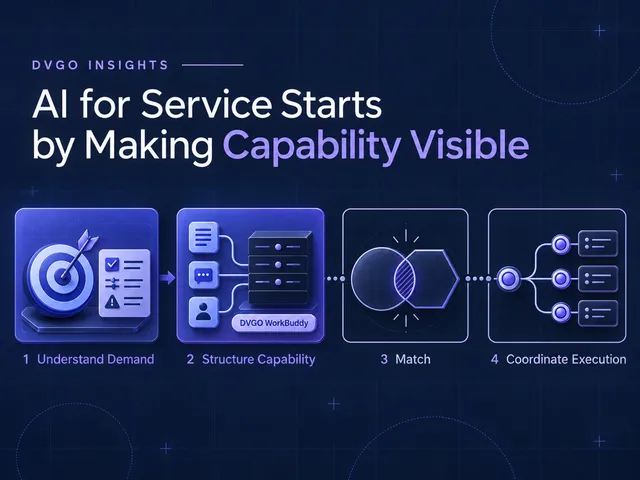
At our July 22 Investor Presentation, we described what we're building — DVGO, our cross-border travel platform — as an AI operating layer, not another booking site or search tool. The distinction we drew there is close to the one Warren draws: DVGO isn't meant to hand a traveler a longer list of options. It's meant to understand what they're actually trying to accomplish, connect that to local capability we trust, and coordinate the pieces through to a finished trip.
The "go get the domain fluency" part of his framework maps onto something concrete in how we grow the network: bringing in local operators, guides, and service partners who already know how their market works, rather than trying to teach a model to know it for them. Because the service is cross-border, that relationship tends to run in both directions — the partner's capability becomes something we can offer, and in time, the partner may become someone the platform serves directly as well, not only a source of supply. That second part is a direction we're building toward, not something we'd claim is proven today.
None of this is a claim that we've solved the model Warren describes. It's a description of the direction, and his framing happens to give useful language for a shape we were already building into DVGO before we'd read his talk.
Data Source: Charlie Warren, "How to Build an AI-Native Services Company," Y Combinator Startup Podcast, June 2026.