

Travel AI is becoming much better at the first conversation. A traveler can describe a family trip across borders, a senior-friendly cultural itinerary or a multi-city business journey—and receive a proposed plan within seconds.
But an international trip is not complete when an itinerary appears on a screen. It still has to work across languages, routes, documentation, local service availability, partner handoffs and unexpected changes.
For us, that raises a practical question: as travel ideas become easier to generate, what does it take to organize an international trip so that it can be supported and delivered reliably in the real world?
That is the question behind the international travel direction DVGO is exploring.
A large market is meeting a new interface
International travel is not a niche use case. Citing UN Tourism’s World Tourism Barometer, the World Economic Forum reported that more than 1.1 billion tourists travelled internationally in the first nine months of 2025—around 50 million more than during the same period in 2024. [1]
AI is also becoming part of the travel decision journey. In a 2025 global traveler survey cited by Amadeus, the share of travelers using generative-AI tools for travel planning rose from 11% to 18% year on year. Yet 25% said they had received outdated or inaccurate information while planning a trip. [2]
The distance between research and a completed booking remains visible. In a June 2026 survey of 1,000 U.S. consumers, Travelport found that 46% had abandoned a booking because it became too complicated or time-consuming. Among respondents using AI for travel needs, 32% used it to research prices and options, while only 8% used it to book their final trip. [3]
These studies cover different geographies and should not be treated as one global consumer profile. Together, however, they frame the change we are watching: AI is making travel discovery and planning easier, while accuracy, confirmation and execution still matter.
Our view: the opportunity extends beyond the itinerary
International travel is a useful lens because the traveler’s request is often only the beginning.
“Plan a two-week cultural trip for my family” may also contain questions about budget, language, mobility needs, entry requirements, local transportation and on-the-ground support. A useful plan has to translate those needs into something a real service provider can understand and act on.
The supply side also needs structure. A local provider’s capability is not simply a place on a map. It may involve a service module, location, capacity, language, availability, price conditions and delivery responsibility.
From our perspective, this is where travel AI becomes more interesting: not only generating an answer, but helping organize the connection between traveler intent and real-world support.
What DVGO is exploring
DVGO is exploring this international travel connection through a working model:
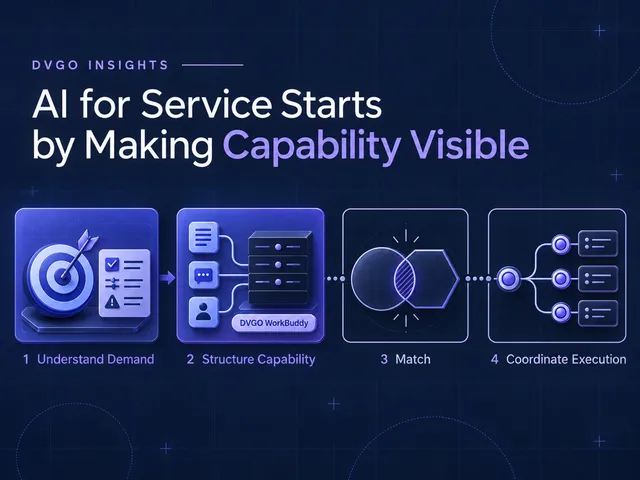
> Travel intent → structured requirement → service matching → partner confirmation → delivery and support → feedback
The model is deliberately practical. Can a complex travel request become a usable service brief? Can relevant partners respond to it? Can the proposed services be confirmed and supported through delivery?
Early progress should therefore be measured through real cases rather than the volume of generated itineraries. Useful evidence may include how many needs can be converted into structured briefs, how long partner confirmation takes, which service modules can be delivered, where human coordination is still required and whether partners choose to use the process again.
These are not public performance targets, and they are not claims that the model has already been commercially validated. They are the questions that can turn an exploration into evidence.
International travel will continue to grow, and AI will continue to make planning easier. DVGO is exploring what comes next: how AI may help organize an international journey so that a useful idea can connect with the real services needed to make it happen.
Sources
[1] World Economic Forum, citing UN Tourism’s World Tourism Barometer, January 2026.
[2] Amadeus, Travel Trends 2026; figures drawn from its 2025 global traveler research.
[3] Travelport, Traveler Confidence Survey, August 2026; survey of 1,000 U.S. consumers conducted by Dynata in June 2026.